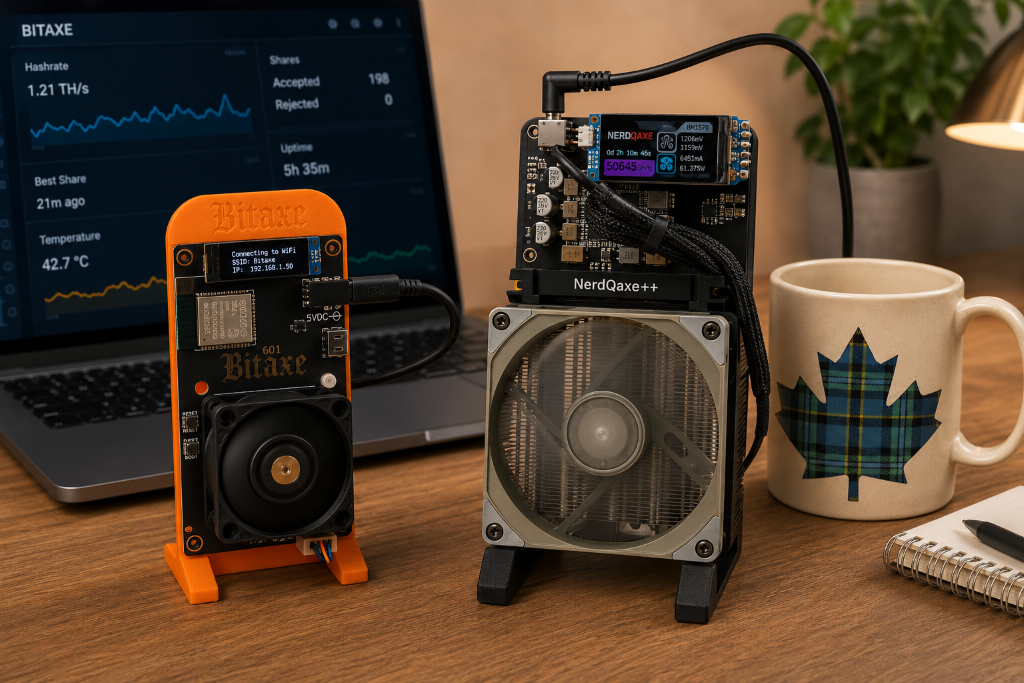
The last couple of weeks have been more about pool architecture and decentralization than about new boards or flashy firmware drops. The latest Bitaxe townhall dug deep into how solo pools, latency, and payout schemes affect decentralization, while Atlas Pool and other open-source efforts continue to push on performance and transparency. (YouTube — Bitaxe Townhall #61)
Pools, decentralization and solo mining
Bitaxe Townhall #61 (July 14, 2026) focused almost entirely on the current state of Bitcoin mining pools, with Scot, WantClue and Matt from Atlas Pool dissecting pool centralization, payout schemes and the practical meaning of “solo mining.” They distinguished “solo mining” as all-or-nothing lottery mining (no reward sharing) while using “pool” to mean any hosted Stratum endpoint that provides work and accepts shares, including solo-style setups like CKPool, Public Pool, Atlas Pool and similar.
A big chunk of the conversation covered how a handful of large FPPS pools (Foundry, Antpool, F2Pool, ViaBTC, etc.) dominate the network, how “Antpool & friends” likely control closer to half the hashrate once template-sharing relationships are accounted for, and why that raises censorship and reorg risk concerns. The townhall also highlighted smaller solo and decentralization-oriented pools (Public Pool, Atlas Pool, PyBlock, Gridpool) as ways for hobby miners — including Bitaxe users — to push hash away from those big hubs.
Atlas Pool’s architecture and latency focus
Atlas Pool’s operator walked through how he’s built the pool with a heavy focus on performance and uptime, using globally distributed Stratum+node endpoints fronted by anycast on AWS. Rather than a single backend region, each Atlas endpoint runs both a Stratum server and a full node locally (per-region), so miners in Europe, Australia or North America are routed to the nearest live endpoint and can fail over to another region automatically if that region has issues.
One key theme was that “latency matters” primarily because slower block notifications translate into more stale work and rejected shares, which is literally wasted electricity at scale. Atlas Pool has been explicitly optimizing both network latency and block notification time (how fast miners hear about a new tip) to reduce stale share rates, and the townhall spent time contrasting that with bigger pools that sometimes home-run anycast endpoints back to a single region.
Stratum v1 vs v2 and job declaration
The townhall also dug into Stratum v1’s limitations and what Stratum v2 brings to the table, especially around miner-selected block templates. Scott emphasized that the real “headline feature” of Stratum v2 and related proposals (like “datim”) is job/templating control: miners (or their local node) can construct their own block templates instead of blindly accepting the pool’s template, which reduces the pool’s ability to silently censor specific transactions.
At the same time, both Scott and Matt noted that most of Stratum v2’s benefits are more meaningful for large pooled miners than for solo miners: features like binary encoding and share batching are nice, but they don’t radically change the experience when you’re running a Bitaxe pointed at a solo pool or your own node. The general takeaway for hobbyists was that Stratum v2 is a welcome evolution, but the “gold standard” remains mining directly to your own node when possible.
Scam pools, transparency tools and AxeOS improvements
Another notable thread was the story of how Atlas Pool’s operator built a script to verify pool block templates and discovered scam “pools” that were secretly proxying users’ hash to BCH backends and pocketing rewards. That work led to public call-outs of specific scam pools listed on common pool-listing sites, and inspired additional tooling like Scott’s “pool checker” script and UI improvements in AxeOS to expose how much of each coinbase payout is actually going to your address.
For Bitaxe users, the practical outcome is that AxeOS can now show coinbase breakdowns, pool scriptSig data and other details directly on the miner dashboard, making it easier to spot suspicious payout splits without needing to decode raw templates by hand. This sits alongside vendor guides (e.g. D-Central, Solo Satoshi) on safe firmware updates and reinforces the message that “trust, but verify” applies just as much to pools as to firmware.
Solo nodes, sovereignty and usability
The closing section of Townhall #61 turned into a frank discussion about what “decentralization” should mean in practice for miners. Scott argued strongly for self-sovereign setups — running a full node and pointing your Bitaxe or Antminer directly at a CKPool/Public Pool-style solo server on your own infrastructure — while acknowledging that the current tooling is still more complex than it should be and that community work (Public Pool, updated CKPool, Gridpool, Go-based pools) has already made huge strides in the last couple of years.
Matt took the “hybrid” view: fully sovereign nodes are ideal for those who can run them, but there should also be well-run, transparent pools for users who lack the time, money or confidence to operate their own node and Stratum stack. Both perspectives agree on the core goal: more options, more open-source implementations and more hash away from opaque mega-pools, with Bitaxe-class devices acting as a kind of gateway drug into that ecosystem.
— Greg Weir, Tartanleaf