
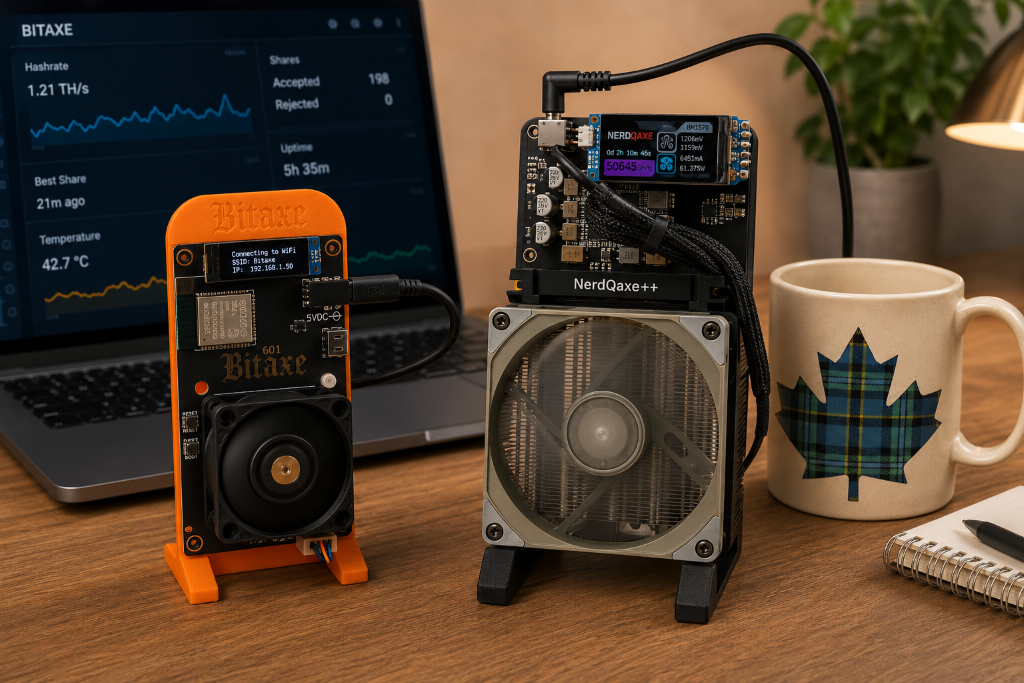
The last month in the Bitaxe and open-hardware mining space has been quieter on the headline-hardware front, but there are still a few threads worth flagging for anyone following Bitaxe, NerdQAxe, and their cousins. The focus remains on firmware polish, broader solo-mining context, and the slow-but-steady creep of BM1373-based designs from rumor toward reality.
Firmware: ESP‑Miner cadence, not drama
On the core Bitaxe side, ESP‑Miner’s release train continues to move, but without a brand-new, post‑June 6 firmware that changes the day-to-day experience for most users. The GitHub releases page still shows the early‑2026 “early access” line as the most recent branch, explicitly framed as a preview/test build rather than a stable, production firmware.
For practical purposes, that means the major firmware storyline over the last 30 days is continuity rather than surprise: the early-access branch remains the place where new features land first, while production-minded users stick to the last stable, focusing on incremental bug fixes and AxeOS update workflows documented by vendors like D‑Central and solomining.de.
If you are already on a recent stable release and comfortable with AxeOS’s “Check latest release” flow, there has been no urgent “drop everything and update” event in late June or early July—just the same slow burn of improvements and documentation refinement.
Solo mining: data, not just anecdotes
While not Bitaxe-specific, the solo-mining story around desktop-class miners kept building in early June with more concrete pool data and coverage. A June 3 report pulled together stats from multiple solo pools—CKPool, Public Pool on Umbrel, and Braiins Solo—showing dozens of verified solo block wins since mid‑2023, including several new ones in 2026.
The piece highlights that solo miners are still occasionally landing full 3.125 BTC rewards (plus fees) with payouts often in the 200,000 to 300,000 USD equivalent range, even as hashpower centralization continues at the farm scale. That may not change the expected-value math for Bitaxe-class rigs, but it reinforces the idea that the “lottery ticket” framing is grounded in fresh, measurable events rather than old legends.
For readers following Bitaxe and NerdQAxe specifically, the implication is that the ecosystem those boards live in—small, often open-source miners pointed at solo or hybrid pools—remains very much alive and statistically visible in pool operator reports.
NerdQAxe++ and “remastered” clones
Outside the Bitaxe.org umbrella, NerdQAxe++ continues to evolve as a Bitaxe-derived, higher‑hashrate option. Mineshop’s 2026 review positions NerdQAxe++ as a 4.8 TH/s, desk‑friendly ASIC miner based on the Bitaxe hardware design, clearly targeting the same hobby/solo‑miner market but with more raw hash on tap.
In late June, TinyChipHub followed up with a beginner‑friendly setup guide for the “NerdQAxe++ Remastered” variant, quoting around 5.2 TH/s ±10% at roughly 80 W, with four BM1370 chips and a very Bitaxe‑like Wi‑Fi/AxeOS configuration flow. The guide is framed squarely at first‑time miners: walk-throughs for joining the built‑in Wi‑Fi network, saving credentials, and making sure the on‑screen SSID matches what your laptop or phone sees.
For anyone already comfortable with Bitaxe, NerdQAxe++ is less about learning new concepts and more about deciding whether the added hash and power draw are worth the incremental cost and noise. In other words: same open‑hardware philosophy, slightly more industrial‑strength implementation.
BM1373: from rumor to practical considerations
The BM1373 conversation is still mostly forward‑looking, but there are a few more grounded hints about how that chip will shape the next wave of Bitaxe‑adjacent hardware. A Facebook discussion from late April, still very relevant in June/July, notes that BM1373 is coming with revised boards and explicitly mentions replacing defective chips in NerdQAxe++–class devices—an early sign that the ecosystem is thinking about repairability and lifecycle, not just performance.
At the same time, vendor content aimed at mainstream buyers has started positioning BM1373-based gear as the “next” step after current Bitaxe Gamma/GT and NerdQAxe++ boards, with some reviews referencing prototype GT‑style miners hitting multi‑TH/s figures on BM1373 while staying within hobby‑friendly power envelopes.
There is still no clear, official “you can buy this BM1373 Bitaxe right now” announcement from Bitaxe.org, but the gravitational pull is obvious: next‑gen chips plus open‑hardware designs are converging; it is just a question of who ships what, when.
What matters for hobby miners right now
Taken together, the last 30 days look less like a “big release” month and more like a consolidation phase for the Bitaxe family and its relatives:
- Firmware: ESP‑Miner’s early‑access line remains active but unchanged in June/early July, with community guides reinforcing safe update paths for AxeOS users.
- Solo mining: fresh pool data confirms that desktop‑class miners—including Bitaxe‑class rigs—are still part of real, verifiable solo block wins in 2026, keeping the lottery metaphor tied to actual outcomes.
- Related devices: NerdQAxe++ and its remastered variants continue to mature as Bitaxe‑inspired options with more hash and power, backed by beginner‑friendly setup guides from vendors like TinyChipHub.
- Hardware horizon: BM1373 is moving from abstract spec sheet to practical design and repair discussions, even if fully mainstream Bitaxe‑branded boards based on it are not yet broadly available.
— Greg Weir, Tartanleaf