The last few weeks have moved the Bitaxe story forward without producing a single headline that explains everything. The more important developments are spread across licensing, firmware maintenance, monitoring and the economics of running small miners.
That combination is a sign of a maturing ecosystem. Bitaxe is no longer just one clever board. It is a family of open hardware, several firmware branches, commercial products, community tools and a growing set of questions about what buyers should expect when a product is described as open source.
Open source is more than publishing a few files
Bitaxe Townhall #63 focused on open-source principles and copyleft licensing. The timing is useful. Bitaxe and related projects now involve designers, firmware developers, manufacturers, vendors and owners in many countries. As that network grows, the words open source need to mean something specific.
Publishing a schematic or a firmware archive is not the same as maintaining a reproducible open project. The useful questions are:
- Is the preferred source available, rather than only a finished binary or fabrication file?
- Does the repository identify a licence?
- Are changes to redistributed versions made available under the terms of that licence?
- Can someone other than the original seller understand, repair and support the exact board revision?
- Are the product name, hardware design and firmware being described separately and accurately?
Copyleft licences are intended to preserve downstream freedom. A company can manufacture and sell an open design, but it cannot quietly take the community’s work, distribute a modified version and ignore the licence obligations that made that work available in the first place.
For an owner, this is practical rather than philosophical. Good source files and documentation make it more likely that a board can be repaired, that firmware support can continue and that a product will not become dependent on one seller.
The Gamma Hex 1300 repository, for example, identifies the hardware as a six-chip BM1370 design and publishes it under the strongly reciprocal CERN Open Hardware Licence. That does not by itself prove production maturity, but it makes the design and the terms under which it can be reused much clearer.
ESP-Miner 2.15.1 is a maintenance release worth noticing
The August 30 update covered the larger changes in ESP-Miner 2.15.0, including unified firmware and mDNS support. Since then, ESP-Miner 2.15.1 has become the current stable release.
Version 2.15.1 is a focused maintenance update. Its published fixes include:
- correcting Swarm IP discovery;
- improving WPA2/WPA3 compatibility;
- preventing reconnect storms caused by slow clients; and
- clarifying the asset message on the update page.
Those are not glamorous features, but network discovery and reconnection behaviour matter on a miner expected to run unattended.
The same firmware advice still applies: do not update simply because a larger version number exists. Record your pool, network, voltage and frequency settings. Confirm support for the exact board revision. Download firmware from the official release page, and update one miner first if you operate several.
There is also an ESP-Miner 2.15.2 release candidate. It adds BM1372/BM1373 driver support and colour-display support for the Naja Duo and Gamma Hex, along with several fixes. It is explicitly labelled a pre-release intended for testing rather than stability. That distinction should be taken seriously. Owners who depend on a stable miner should normally remain on the stable release unless they have a specific reason to test a release candidate and a recovery path if it fails.
Gamma Hex moves from a repository toward firmware support
I introduced the Gamma Hex 1300 in the previous update, so it should not be treated as a brand-new announcement. The useful change is that firmware support is beginning to catch up with the hardware repository.
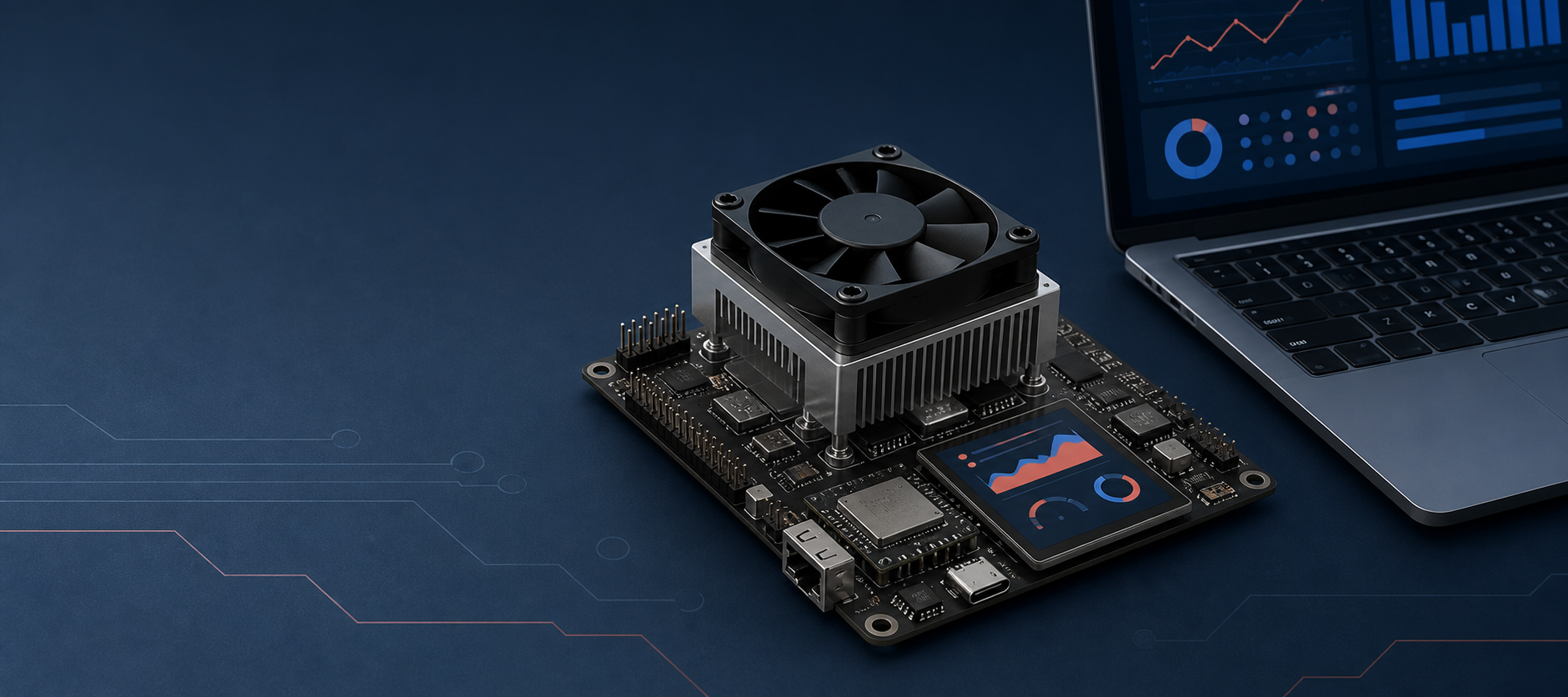
The design remains a six-chip BM1370 board with a 12-volt input, ESP32-S3 controller, colour display, adjustable voltage regulation and dual ASIC-temperature monitoring. The repository is still small and does not publish a hardware release. The addition of display support in the 2.15.2 release candidate is evidence of active integration, not evidence that the model is ready for every buyer.
This is a good example of the stages an open miner passes through:
- A design appears in a public repository.
- Contributors review and revise the hardware.
- Firmware learns to identify and operate the board.
- Builders produce working units.
- Owners accumulate useful experience with power, cooling and reliability.
Those stages can overlap, but they are not interchangeable. A repository and a firmware pull request are encouraging; production availability and field experience are different milestones.
HashWatcher offers a broader view of several miners
HashWatcher is a third-party Android application that supports Bitaxe and NerdQaxe++ miners alongside several larger-miner platforms. Its listing describes fleet monitoring, temperature alerts, charts, reports and custom overclock controls for supported small miners.
This addresses a real limitation of browser-based dashboards. AxeOS is convenient when working with one miner. It becomes less convenient when every unit has a separate address and you want to see at a glance which miner is hot, offline or underperforming.
The developer says miner data is fetched directly from the devices and that no third-party cloud is required. The Google Play data-safety declaration currently says that the app does not collect or share data. Those are useful statements, but they do not remove the need for normal care.
Before allowing any monitoring application to change miner settings:
- confirm that you have the correct app and developer;
- review its permissions and privacy information;
- begin with monitoring before using tuning controls;
- keep a record of known-good voltage and frequency settings; and
- remember that a convenient control can still request an unsafe setting.
Remote visibility is useful. It should not replace local records, temperature limits or a recovery plan.
Mining economics continue to favour efficiency
Hashrate Index’s September 14 roundup placed spot hashprice at about US$39.25 per PH/s per day. It reported a seven-day network-hashrate average near 943 EH/s and estimated a 5.26% difficulty increase for September 19. Its six-month forward market was pricing average hashprice around US$36.92 per PH/s per day.
These figures are dated observations, not forecasts that should be treated as certain. Difficulty, Bitcoin price, transaction fees and network hashrate all move.
They also need to be interpreted carefully for a Bitaxe. Hashprice is useful for comparing expected mining revenue at scale. A small solo miner has a very different experience: most days produce no payout at all, while a successful block is a rare event. The expected value can be estimated, but the actual result is highly variable.
The broader lesson is still valid. Hashrate affects the probability of finding work, while joules per terahash determine how much electricity is required to sustain that probability. Hashrate Index’s fleet figures showed substantially more revenue per unit of energy for equipment below 14 J/TH than for less efficient groups. Those are fleet-level comparisons, not promises for a desktop miner, but they explain why efficiency matters as network conditions become less forgiving.
For many Bitaxe owners, the objective is learning, supporting open mining, experimenting with heat reuse or taking a very small chance at a solo block—not earning dependable income. A good purchase decision begins by stating that objective honestly.
What I would do now
For an existing owner, the mid-September priorities are straightforward:
- Treat ESP-Miner 2.15.1 as the current stable maintenance release and read its notes before updating.
- Treat 2.15.2 as test firmware until a stable release replaces it.
- Verify the hardware repository, licence and exact board revision when evaluating an “open-source” product.
- Use fleet-monitoring tools as a convenience layer, not as a substitute for safe settings and local records.
- Compare miners by efficiency, power, cooling, firmware support and maturity—not hashrate alone.
The Bitaxe ecosystem is becoming more capable, but also more specialized. That makes careful documentation more important, not less. The best projects will be the ones that combine transparent licensing, reproducible hardware, maintainable firmware and honest descriptions of what is ready today.
I will continue updating the Bitcoin Mining with Bitaxe Updates page as stable firmware and production experience catch up with the announcements.
For a practical guide to setup, tuning, monitoring and recovery, see Bitcoin Mining with Bitaxe. The free Bitaxe Owner’s Maintenance and Troubleshooting Pack provides printable baseline and troubleshooting worksheets.
— Greg Weir, Tartanleaf
Sources and verification notes
- Bitaxe Townhall #63, discussion of open-source principles and copyleft.
- ESP-Miner 2.15.1 release notes, released August 29, 2026.
- ESP-Miner releases, including the 2.15.2 release candidate and its pre-release warning.
- Bitaxe Gamma Hex repository, hardware description and CERN-OHL-S-2.0 licence.
- HashWatcher Google Play listing, updated September 12, 2026. Feature, privacy and data-safety statements are developer declarations.
- Hashrate Index Roundup, September 14, 2026. Market and network figures are time-sensitive.