
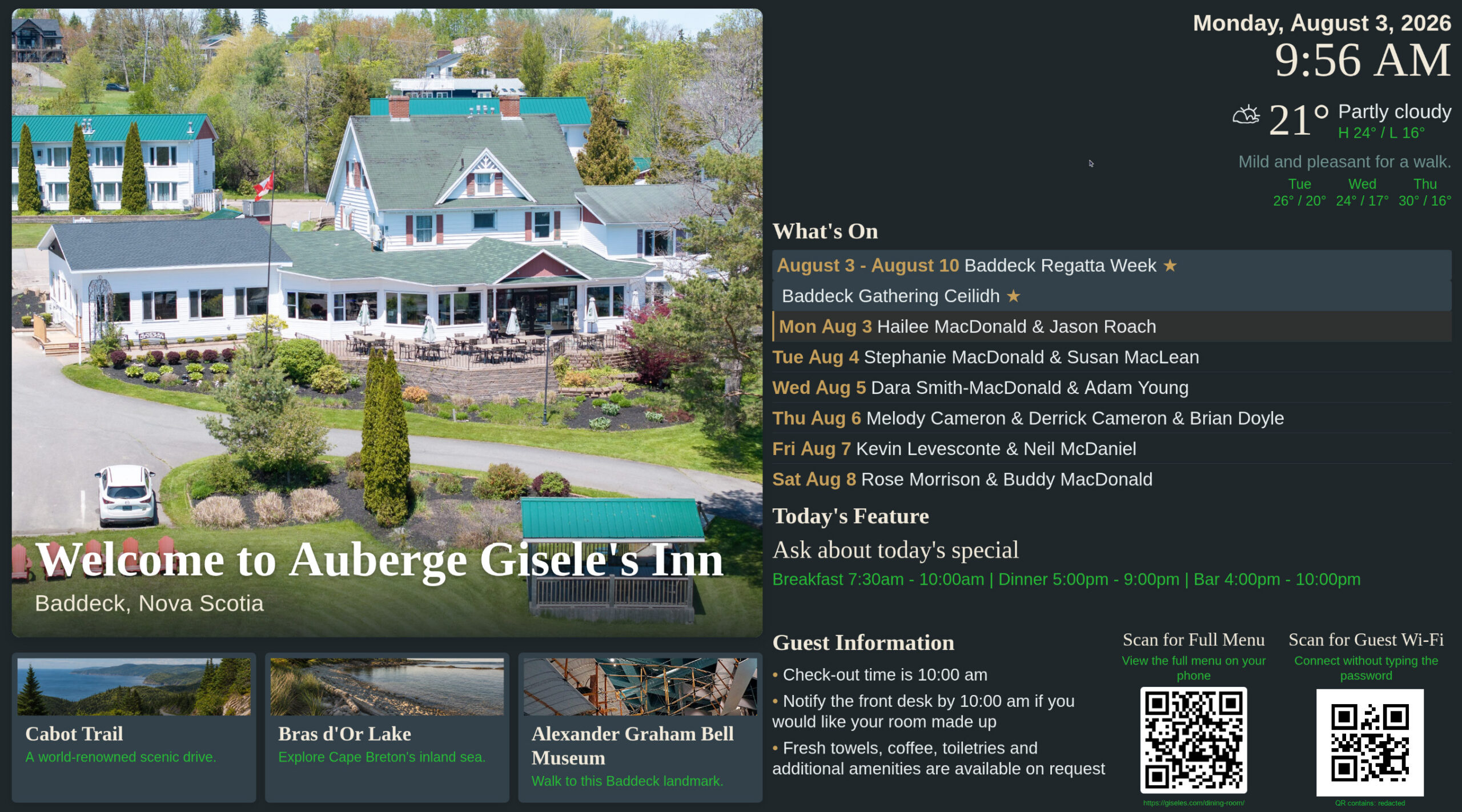
At a busy inn, many front-desk questions are simple but time-sensitive. Guests want the Wi-Fi password, the weather forecast or the menu. Before Open Lobby Board was installed at Auberge Gisele’s Inn in Baddeck, staff generally supplied that information verbally.
I installed the board in the lobby and had it running around the end of June 2026. It puts commonly requested information on a lobby display, runs on a Raspberry Pi and remains under the property’s control. Management can update it from the trusted local network without maintaining a cloud account or paying for another subscription.
The useful features were the ordinary ones
It would be easy to judge a lobby display by the number of features it offers. The more useful question is which information guests actually look for.
Wahab Khan, General Manager, identified three practical items: the Wi-Fi password, the weather and the menu. Of those, the clearest observed change involved the weather. He reports that weather questions at the front desk have “really gone down.”
That is a modest result, but it is also a useful one. The board does not need to replace the front desk or automate every interaction. It only needs to make routine information visible enough that guests can find it without waiting to ask.
What the evidence does not show
The board also includes a menu QR code. Gisele’s keeps a physical menu at the front desk, and guests usually refer to it. As a result, this installation does not show that the QR code reduced requests for paper menus.
Khan believes the QR code would be useful where a paper copy was not readily available. That is a reasonable use case, but it is different from an observed result. The distinction matters in a practical case study.
Easy updates and no reported reliability burden
A display is only useful if the information stays current. Khan describes the board as easy to read and extremely easy for management to edit. He also reports that it has been “extremely reliable” and has had “zero issues.”
Those observations support the project’s original design priorities: keep the interface straightforward, keep routine changes simple and avoid turning an information screen into another service that requires continuing administration.
Local control is part of the value
Open Lobby Board is designed for a Raspberry Pi connected to a display on a trusted, non-routable local network. The display has no subscription requirement or advertising service and is managed locally. Weather information comes from Open-Meteo, an external service. It is an open-source example project rather than a managed product, and it should not be exposed directly to the public Internet.
For a property in a high-volume tourism town, Khan sees value in any practical way to reduce repeated questions. The Gisele’s installation suggests that the strongest case for a lobby board may not be a long feature list. It may simply be dependable access to the few pieces of information guests ask for most often.
About Open Lobby Board
I developed Open Lobby Board and released it through Tartanleaf.com Inc. as a free, open-source community project under the MIT License. It is provided as an example for technically comfortable operators, not as a hosted or supported commercial service.
View Open Lobby Board and its setup documentation on GitHub, or see it alongside Tartanleaf’s other resources on the Tartanleaf Tools page.