
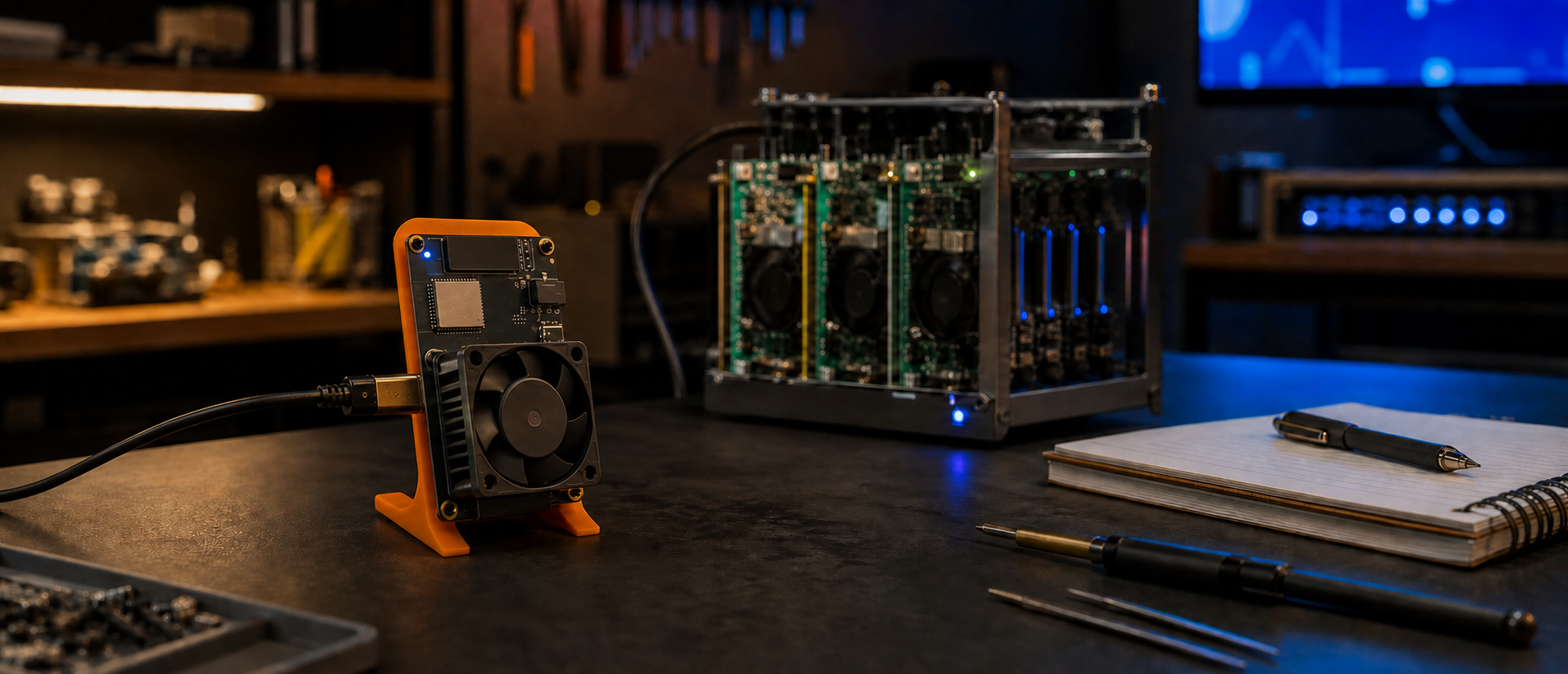
A palm-sized Gamma found a full Bitcoin block, ESP-Miner moved into the 2.14 series, and multi-chip open-hardware miners continued to stretch what a desktop rig can do. Here is what matters—and what still belongs in the “wait and see” column.
A Bitaxe Gamma finds block 957,382
On July 9, a miner using a single Bitaxe Gamma through Public Pool found Bitcoin block 957,382. The block paid 3.1382 BTC, including the 3.125 BTC subsidy and transaction fees. The block itself can be checked independently on mempool.space, while coverage of the miner and hardware identified the device as a Gamma running at roughly 995 GH/s to 1 TH/s. The reward was worth about US$200,000 at the time.
The detail that caught most headlines was the contrast: a miner costing roughly US$150 found a full block after about eight hours online. It is a wonderful result, but it needs the right interpretation. Eight hours was the winner’s actual runtime, not the expected time to find a block. At that hashrate, a solo block remains an extraordinarily rare event.
I still think “lottery miner” is a useful shorthand, provided we do not let the metaphor turn into a promise. A Bitaxe does real work and submits real shares to the Bitcoin network. It also gives its owner a very small chance of finding a block. The July win is proof that the chance is not zero; it is not evidence of predictable income.
What makes the story worthwhile is not simply the payout. A small open-source miner became part of Bitcoin’s permanent history. That is a remarkable outcome for hardware that can sit on a desk.
ESP-Miner is now in the 2.14 series
The firmware picture also changed this summer. The current production release listed by the project is ESP-Miner 2.14.2, issued in July. It follows the much larger 2.14.0 release, which added a customizable AxeOS dashboard, better mobile presentation, downloadable logs, pause and resume controls, a WebSocket API, and Stratum V2 support. The 2.14.2 maintenance release fixes a race condition and improves frequency fallback during self-test.
This is not an emergency update story. It is a reminder to check the release notes, confirm that the image matches your board, and use the project’s documented update path. If a miner is stable, there is no prize for being the first person to install every release. Back up or record your settings, avoid interrupting power during an update, and leave experimental builds to situations where you are prepared to troubleshoot them.
BM1373: interesting, but not yet a Bitaxe product
There is growing community interest in Bitmain’s newer BM1373 ASIC, with discussion centred on higher per-chip hashrate and the possibility of a future generation of compact miners. For now, I would resist attaching firm specifications or shipping dates to a future Bitaxe. The official Bitaxe organization’s published hardware list still identifies the Gamma and Gamma Turbo as BM1370 designs; it does not list a generally available BM1373 Bitaxe.
That does not mean nothing is happening. Chips are appearing in the broader home-mining conversation, and open-hardware developers are clearly exploring what comes next. But chip availability, board design, power delivery, cooling, firmware support, and manufacturability all have to come together before an interesting ASIC becomes a dependable product.
The practical consequence may arrive before the new hardware does: anticipation of a next generation can soften prices on current Gamma boards. A discounted BM1370 miner does not suddenly become obsolete. For learning, experimenting, running a node-adjacent appliance, or taking a very long solo chance, the current hardware still does exactly what it did before.
NerdQAxe++ shows what more chips—and more power—can do
The NerdQAxe++ is not a Bitaxe, but it belongs in the same open-hardware home-mining conversation. A four-chip BM1370 model gives builders another way to balance hashrate, heat, noise, and power on a desktop.
Vendor figures vary by revision and cooling configuration. TinyChipHub describes its NerdQAxe++ Remastered at about 5.2 TH/s and 80 W in its normal configuration, with its own internal testing reaching about 6 TH/s at 100–110 W. Solo Satoshi reports that Revision 7 runs at roughly 4.8 TH/s and 69.5 W at stock settings, with substantially more overclocking headroom after a redesign of the power-delivery system.
Those are vendor measurements rather than universal guarantees. They are also a useful illustration of the engineering trade-off. More frequency and more chips can produce more hashrate, but they also require better power delivery and cooling. The impressive number is not always the setting you would choose for quiet, efficient, continuous operation.
Multi-device setups add another possibility. Several small miners can point at the same pool or be managed as a small home fleet. That makes the Bitaxe useful not only as a standalone solo miner, but also as a modular building block. It does not improve the economics by magic; it simply lets the owner add hashrate in manageable steps.
The larger lesson
The Gamma block win will understandably receive most of the attention. My larger takeaway is that open-source home mining continues to mature around it. Firmware is becoming more capable, multi-chip designs are becoming more refined, and the next ASIC generation is close enough to provoke serious discussion.
None of that changes the basic advice: buy a small miner because you want to learn, experiment, support open hardware, or participate directly in proof-of-work—not because a headline makes the payout look repeatable.
Sometimes, however, the long shot lands. In July 2026, one Bitaxe Gamma proved it.