Author: Greg Weir

  • Bitaxe Town Hall #60: The Libre Board and the Future of Open-Source Mining

    Bitaxe Town Hall #60: The Libre Board and the Future of Open-Source Mining

    The 60th Bitaxe Town Hall, hosted as always by WantClue, featured a special guest this week: Schnitzel, the creator of the Libre Board—a fully open-source control board for Bitcoin miners. Originally from Switzerland and now based in Virginia, USA, Schnitzel is a software engineer whose passion for heat reuse and open hardware has led to one of the most exciting developments in the Bitaxe ecosystem.

    From S9s to the Libre Board

    Schnitzel’s journey into Bitcoin mining began around 2020 with Antminer S9s. His primary motivation wasn’t just mining Bitcoin—it was heat reuse. He used miners to heat garages, an Airstream trailer, a hot tub, and eventually his house. But he quickly ran into a frustrating reality: controlling stock miners for custom setups was nearly impossible with closed-source control boards.

    This frustration pushed him toward the 256 Foundation’s open-source ecosystem and ultimately inspired the Libre Board, funded by a grant from the foundation.

    What Is the Libre Board?

    The Libre Board is designed as a powerful, open-source replacement for the proprietary control boards found in miners like the Bitmain S19 or S21. Its design philosophy is refreshingly pragmatic:

    • Reuse existing standards: USB-C for hashboard communication, Qwiic (I²C) for sensors and displays, and standard Raspberry Pi HATs for expandability.
    • Modular compute: Built around the Raspberry Pi Compute Module 5 (CM5), using the standard 200-pin interface. Users can choose anything from a basic 1GB module to a 16GB multi-core—or even third-party RISC-V alternatives.
    • All-in-one controller: Unlike stock boards that need an external Raspberry Pi for complex tasks, the Libre Board integrates everything. You can run mining firmware, a Bitcoin full node, home automation (like Home Assistant), and custom logic on a single board.

    Hardware Highlights

    The Libre Board is packed with features that make it incredibly versatile:

    • 4x USB-C ports for hashboards, expandable via standard USB hubs. This means you can mix and match different hashboard models—S19, S21, even Bitaxe Raw—all on one controller.
    • 12–24V DC input with onboard voltage regulators, making it compatible with car batteries or direct solar panel connections.
    • M.2 slot for NVMe SSDs—perfect for running a full Bitcoin node.
    • USB 3, Ethernet, Wi-Fi/Bluetooth (via CM5), HDMI, and MIPI display port.
    • 4x 12V fan headers with full RPM control.
    • Qwiic connector for daisy-chaining temperature sensors, pumps, displays, cameras, and more.
    • Pi HAT compatibility, SD card slot, real-time clock battery, and an RGB status LED.

    Machina: The “Linux Kernel” of Mining

    Schnitzel also discussed Machina, the open-source firmware being developed by the 256 Foundation (led by Ryan). He described it as the “Linux kernel” of mining—universal, adaptable, and designed to support any hashboard, not just one manufacturer.

    Support for the Bitaxe Raw already exists, and support for Bitmain S19 J Pro, S19 K Pro, and S21 is actively being added.

    AI-Assisted Reverse Engineering

    One of the most fascinating parts of the discussion was how the team is using AI to reverse-engineer proprietary firmware. By sniffing the I²C communication between stock firmware and hashboards, they can rapidly generate drivers for Machina—sometimes in as little as 30 minutes.

    This approach opens the door to advanced features that current firmware simply doesn’t offer:

    • Per-hashboard power tuning and voltage control
    • Dynamically disabling boards to reduce power draw (ideal for solar or battery setups)
    • Custom ramp-up/ramp-down curves managed by AI for specific use cases

    The Doomaxe: Mining Meets Gaming

    To demonstrate the Libre Board’s potential, Schnitzel built the Doomaxe—a fully portable, battery-powered, open-source Bitcoin miner. It made its debut at a Las Vegas mining conference and turned more than a few heads.

    The build combines a Libre Board, Bitaxe Raw hashboard, battery pack, fan, SSD, and touchscreen. But the name came from something even cooler: Schnitzel successfully ran the classic video game Doom on a small OLED screen connected via Qwiic. Hence, Doomaxe—Doom meets Bitaxe.

    It’s a fun demo, but it also represents something bigger: what Schnitzel believes is the first fully open-source, battery-powered Bitcoin miner (hardware and software), with the only closed component being the ASIC chip itself.

    The Future: Heat Reuse as a Household Appliance

    Schnitzel’s ultimate vision goes beyond hobbyist mining. He sees a future where Bitcoin mining is integrated into everyday appliances through heat reuse:

    Imagine buying a water heater or home heater at a hardware store for a fraction of the normal price—because it contains a miner. The homeowner gets cheap heat, while the manufacturer recoups the cost through Bitcoin mining rewards. Because the Libre Board is open-source, any manufacturer can produce it, enabling variants like a “Libre Board Light” or a “Max” version from different producers around the world.

    Current Status and How to Get Involved

    The Libre Board is currently at the prototype stage. Only two Revision 2 boards exist, and the team discovered issues with the USB controller that are being addressed in Revision 3.

    Schnitzel is actively soliciting feedback on use cases before Rev 3 is finalized to ensure all necessary ports and features are included. Once Rev 3 is tested, the goal is for any producer with a pick-and-place machine to begin manufacturing. Interested producers and community members are invited to reach out for a potential small test run.

    If you’re interested in the future of open-source Bitcoin mining, the Libre Board is one of the most exciting projects to watch.

    Want to stay updated on Bitaxe developments? Get the book and join the community.

  • 12 Practical Technology Guides That Respect Your Time

    12 Practical Technology Guides That Respect Your Time

    Technology is supposed to make life easier. For too many people, it does the opposite — it creates confusion, anxiety, and a sense that you are always behind. The problem is not you. The problem is that most technology is designed for engineers, sold by marketers, and explained by people who forgot what it is like to not know. Smart Tech for Real People is a series of practical technology guides that fix this. Each book tackles a specific topic with clear explanations, actionable steps, and a focus on what actually matters in your daily life.

    The Philosophy Behind Practical Technology Guides

    Every book in this series follows three principles:

    • Clarity over completeness — I cover what you need to know, not everything that could possibly be said. No filler, no fluff, no 500-page tomes that never get read.
    • Action over theory — You should finish a book with something you can do differently today. Not vague advice, not inspirational fluff. Concrete steps.
    • Respect for your time — You are busy. I assume you are reading because you want to solve a problem or understand something, not because you have nothing better to do. Every section earns its place.

    Practical Technology Guides: The Series So Far

    practical technology guides for everyday users

    Smart Tech for Real People currently covers twelve topics, with more practical technology guides in development:

    Digital Foundations

    • Digital Literacy — Understanding the technology you use every day. How computers, phones, and the internet actually work, without the jargon.
    • Privacy & Cybersecurity — Protecting your accounts, devices, and information. Practical security for real people who do not have an IT department.
    • Online Privacy — Controlling what the internet knows about you. Browser settings, search alternatives, and habits that actually matter.

    Home & Network

    • Home Networking — Wi-Fi, routers, and getting the most from your internet. Fix dead zones, understand speed tests, and stop paying for bandwidth you cannot use.
    • Family Internet Safety — Protecting children and managing shared home internet. Parental controls, screen time, and conversations that work.
    • Smart Homes — Making your home work for you, simply and securely. Automation without surveillance, convenience without complexity.

    Self-Hosting & Independence

    • The Modern Homelab — Your home, your servers, your rules. Run services at home without turning your basement into a data center.
    • Self-Hosting — Own your data, run your services, control your digital life. Email, cloud storage, calendars, and more — on your own hardware.
    • Local AI — Run AI on your own hardware with no cloud or subscriptions. Private, fast, and surprisingly capable.
    • Personal AI Assistants — AI that works for you, on your terms, on your devices. No creepy listening, no data harvesting, no subscription lock-in.
    • AI Tools for Everyday Life — Practical AI for real people, no hype or coding required. Writing, research, images, and productivity — explained clearly.

    Accessible Technology

    • Smart Tech for Seniors — Technology that works for you, not against you. Designed for older adults who want to stay connected without frustration.

    Why Practical Technology Guides Need the Book Format

    I chose a book series over a blog or video channel because books force discipline. A blog post can be helpful but it is usually narrow — one tip, one trick, one explanation. A book demands a complete, coherent treatment of a topic. It has to flow. It has to connect ideas. It has to be readable cover-to-cover or usable as a reference.

    That is what these practical technology guides aim to be: a reference library you can actually use. Not a collection of blog posts bound together, but real books written as real books.

    What Is Next for Practical Technology Guides

    The first batch of practical technology guides is in editing and production. I will release them as they are ready, starting with the topics that have the clearest demand. The website pages above will be updated with availability information, sample chapters, and links to purchase as each book launches.

    If you want to follow the series, the best way is to subscribe to the Smart Tech newsletter. I will send updates when new books are available, when existing books get updated, and when I publish related guides or tools.

    Explore the Smart Tech series →

    Subscribe to Smart Tech updates →

    For more on digital literacy and privacy, the Federal Trade Commission Consumer Advice and the Electronic Frontier Foundation are excellent resources for staying informed about online privacy and security.

  • RadioBook: The Complete Amateur Radio Learning System (5 Books + 12 Games)

    RadioBook: The Complete Amateur Radio Learning System (5 Books + 12 Games)

    Publication update — July 13, 2026: All five RadioBook volumes and both the Canadian and U.S. Ham Radio Answer Guides are now available in paperback and Kindle on Amazon. The companion game suite remains free at RadioBook.ca.

    Amateur radio learning should not be intimidating. Yet for most people, it is — because the resources are outdated, overly technical, or assume you already know electronics. RadioBook is designed to change that. It is a complete amateur radio learning system built for modern learners: five practical books paired with twelve interactive browser-based experiences. Each book covers a core area of ham radio knowledge, and each game or drill reinforces what you learn with hands-on practice. No installation, no coding, no cost.

    What You Get

    • Five practical books — From basic concepts to advanced operating techniques
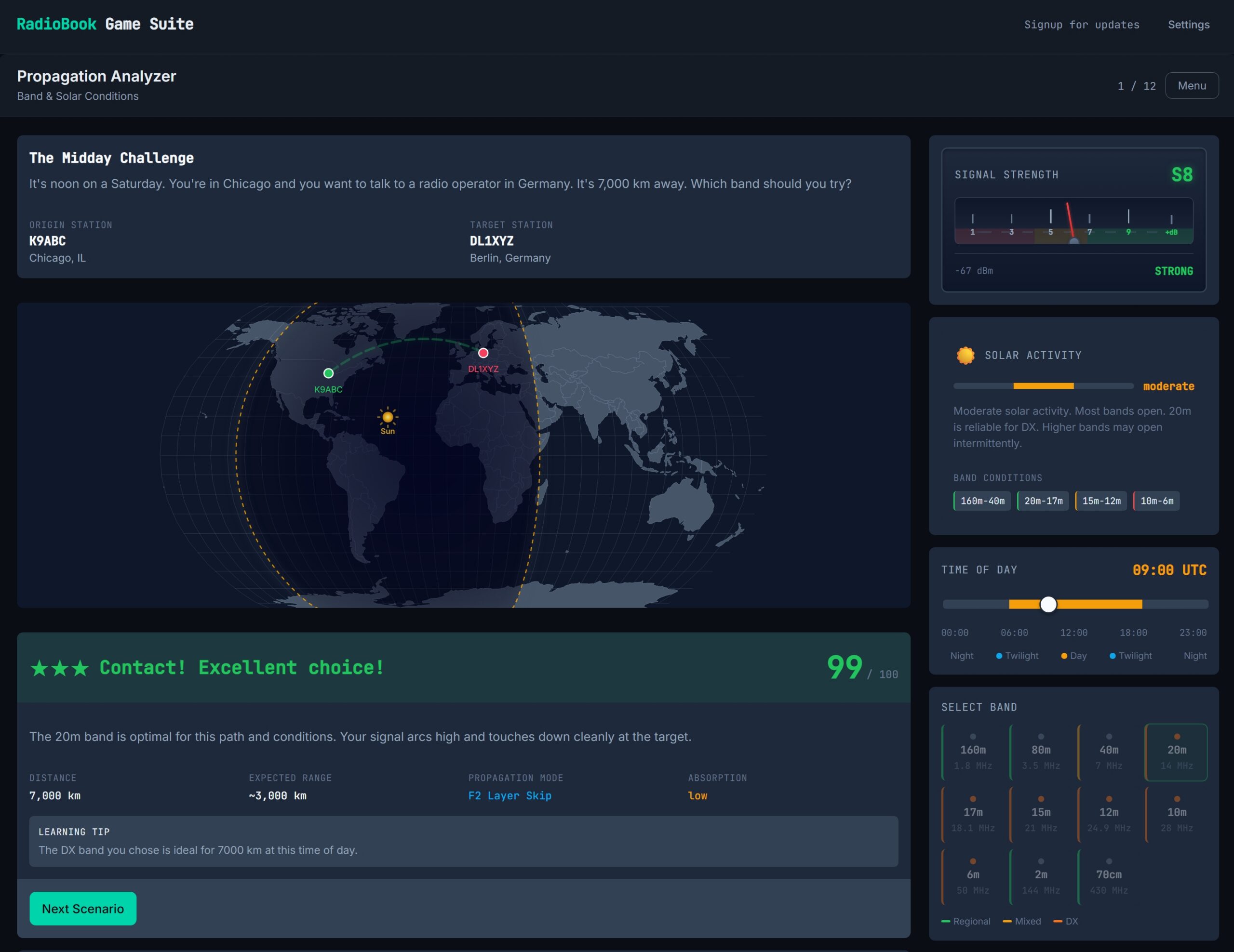
    • Twelve interactive games — Browser-based drills, simulations, and practice exams
    • Self-paced structure — Learn at your own speed with clear milestones
    • Real-world focus — Every concept tied to actual operating scenarios

    The Books

    Each RadioBook volume is designed as a standalone guide while building on previous knowledge:

    • Volume 1: Foundations — Basic concepts, regulations, and getting started
    • Volume 2: Operating — Practical on-air techniques and procedures
    • Volume 3: Electronics — Circuit theory, components, and troubleshooting
    • Volume 4: Antennas — Design, construction, and optimization
    • Volume 5: Advanced — Digital modes, satellites, and specialized operations

    The Games

    Twelve browser-based experiences reinforce every concept:

    • Morse code practice with adjustable speed
    • Band plan navigation and frequency identification
    • Antenna modeling and pattern visualization
    • QSO simulation with realistic propagation
    • Exam preparation with adaptive questioning

    Availability

    All five RadioBook volumes and both Answer Guides are now available in paperback and Kindle formats. Visit the RadioBook page for purchase links and the companion game suite.

  • Bitaxe Firmware Update — Corrected June 2026 Timeline

    Bitaxe Firmware Update — Corrected June 2026 Timeline

    Correction — August 12, 2026: The original version of this article incorrectly described ESP‑Miner v2.8.1 as a June 2026 release. It also contained duplicated draft text and unsupported hardware and mining-difficulty speculation. The article has been replaced with the verified release timeline below, based on the official ESP‑Miner repository.

    Around mid-June 2026, the clearest Bitaxe development was continuing work on ESP‑Miner and AxeOS. The official release history shows that v2.14.0b4—not v2.8.1—was the most recent published pre-release before the original June 13 article date.

    May 29: ESP‑Miner v2.14.0b4

    ESP‑Miner v2.14.0b4 was published as a pre-release on May 29. Its release notes include WebSocket API work, pool-disconnect handling, improved dashboard performance, measurement of Stratum V2 share-response time, and a TCP change intended to reduce Stratum V2 submission latency.

    June 19: ESP‑Miner v2.14.1

    ESP‑Miner v2.14.1 followed on June 19, after the original article date. The official notes list Bitaxe 603 support, a configurable self-test warm-up temperature, a swarm-device editing fix, and a fix for a buffer overflow in rejected-share statistics.

    July 8: ESP‑Miner v2.14.2

    ESP‑Miner v2.14.2 was published on July 8. Its release notes describe a use-after-free race-condition fix and a self-test frequency fallback correction.

    What Bitaxe owners should take from this

    Firmware development was active, but version numbers and hardware support were changing quickly. Before updating, read the official release notes, confirm that the firmware image matches your board, record your working configuration, and have a rollback plan. Newer is not automatically better for every device or setup.

    For a step-by-step decision process, see Should You Update Bitaxe Firmware? A Low-Risk Decision Process. For the current upstream state, use the official ESP‑Miner releases page.

    This correction intentionally removes the earlier unsourced claims about solo-mining coverage, BM1373 availability, and a projected network-difficulty change. Those subjects require their own dated, primary-source-supported reporting.

  • Bitaxe Community Update – Mid‑May 2026

    Bitaxe Community Update – Mid‑May 2026

    Over the past few weeks the Bitaxe ecosystem has kept up a steady pace of firmware work, tuning, and future‑hardware discussion, even without a brand‑new board release. Here are the key highlights for hobbyists and solo miners.

    Firmware and ESP‑Miner progress

    Development on the ESP‑Miner firmware (the core firmware for Bitaxe boards) continues at a rapid clip. The Bitaxe.org GitHub org remains very active, with ongoing changes across the miner core, web UI, and API.github+1

    • The current “early access” branch for 2026 is being treated as a canary / preview line rather than a stable release. Maintainers explicitly flag it as test‑only, with merged pull requests reflecting in‑progress features for adventurous users.
    • Recent ESP‑Miner release notes emphasize quality‑of‑life improvements: better pool‑failover behavior, clearer log messages, and refinements to the built‑in self‑test and fan control routines. This includes fixes to self‑test timeouts, improved reporting of current and voltage, and small UI adjustments.

    For most home miners, the takeaway is that firmware is still evolving, with more attention on stability, diagnostics, and pool behavior rather than on headline‑grabbing features.

    Overclocking and performance tuning

    Late‑March and early‑April content has turned into practical tuning guidance that’s still very current in May. Solo Satoshi posted a detailed 2026 overclocking guide that walks through safe voltage and frequency bands for the current Bitaxe lineup, including Gamma, Supra, Ultra, Hex, and GT.

    • The guide breaks out per‑model suggestions instead of one “max everything” setting, and repeatedly stresses realistic PSU sizing, cooling, and 24/7 stability.
    • Community posts and vendor guides now converge on the idea that fine‑tuned firmware + airflow + good PSUs matter as much as raw MHz when you’re trying to squeeze more GH/s out of BM1368/BM1370 boards without cooking them.d‑central+1

    If you’re already running current firmware, the main “new” value here is better, battle‑tested reference points for long‑term stable clocks rather than guesswork.

    Bitaxe in solo‑mining discussions

    Even though no new Bitaxe hardware has dropped in the last month, Bitaxe still features prominently in fresh solo‑mining coverage:

    • A May 2026 deep‑dive on solo mining uses Bitaxe and NerdQAxe setups as concrete examples, citing six documented solo block wins by open‑source miners (Bitaxe Ultra, Bitaxe Gamma, clusters, NerdQAxe++ and similar) between March 2025 and early 2026.millionminer+1
    • Those pieces drive home the same point many in the community have been making: the odds are long, but real blocks have been found by “hand‑sized” miners, anchoring all the probability calculators in actual outcomes.d‑central+1

    From a narrative standpoint, Bitaxe has shifted from “experimental curiosity” to a case‑study device for realistic solo‑mining odds.

    Hardware outlook: BM1373 on the horizon

    On the hardware side, the last few weeks have brought more talk about the next generation of chips rather than boards you can buy today:

    • A late‑April community update highlighted Bitmain’s new BM1373 ASIC, noting that it’s expected to power upcoming Bitaxe and NerdQAxe designs.
    • The same discussion mentions that as BM1373‑based gear approaches market, BM1370‑based miners are already seeing price pressure, making current‑gen boards more affordable for hobbyists.

    Nothing is shipping yet under the Bitaxe.org banner with BM1373, but it’s now being discussed explicitly as the likely foundation for “next‑wave” Bitaxe and NerdQAxe hardware.

    Market / ecosystem context

    Broader miner roundups and buying guides updated this year still place Bitaxe firmly in the 2026 hobby‑mining landscape:

    • Recent USB/BTC‑miner guides list the Bitaxe Gamma series as a standout for hobby solo mining, quoting ~1.1–1.3 TH/s at around 18–20 W, and positioning it as an efficient, open‑source alternative in a market full of proprietary sticks.
    • Bitaxe comparison and buying guides from early 2026 continue to describe Gamma and GT as the “serious solo” options, with Supra and Ultra remaining popular, mature boards for entry‑level and tinkering.d‑central+1

    For anyone just discovering Bitaxe now, that means the current generation is still very relevant while the community quietly prepares for BM1373‑based successors.

    Want to start mining? If you’re ready to build your own Bitaxe, check out the Bitcoin Mining with Bitaxe guide for a complete beginner-friendly walkthrough. And for the latest news, see the June 2026 community update.

    Bitaxe Community Update May 2026

  • Bitcoin Mining with Bitaxe — Now Available!

    Bitcoin Mining with Bitaxe — Now Available!

    Today I finally get to share the reason for the recent silence: my new book, Bitcoin Mining with Bitaxe, is now available.

    This project began with a simple goal: create a clear, practical guide for people who want to understand Bitcoin mining without needing warehouse-scale equipment or an electrical-engineering background. It grew into a complete, beginner-friendly walkthrough of building, configuring, and operating a Bitaxe miner at home.

    What the guide covers

    • How Bitcoin mining works, from the ASIC to the blockchain
    • Hardware setup, power, cooling, networking, and safe operation
    • Firmware configuration and connecting to pool or solo-mining services
    • Monitoring, maintenance, tuning, and practical troubleshooting
    • Realistic expectations about efficiency, payouts, and the very long odds of solo mining

    A practical view of home mining

    Solo mining is a long shot—a technical lottery with very poor odds—but a small open-source miner is also a hands-on way to learn how proof of work functions, experiment with real hardware, and participate in Bitcoin without running an industrial operation. The book treats that tradeoff honestly and focuses on learning, safe operation, and useful experimentation.

    Where to find the book

    View Bitcoin Mining with Bitaxe on Amazon

    You can also visit the book page for the description, formats, and supporting material.

    This release also marks the beginning of the broader Smart Tech for Real People publishing program. You can browse all Tartanleaf books for the current catalogue.

    If you pick up the book, I hope it helps you understand what your Bitaxe is doing, operate it safely, and get more out of the experience.

    Updated August 12, 2026: Removed duplicated and autogenerated filler text and reorganized the announcement for clarity. The publication details and destination links are unchanged.

  • Bitcoin Mining with Bitaxe — Living Updates, Addendums, and Ongoing Notes

    Bitcoin Mining with Bitaxe — Living Updates, Addendums, and Ongoing Notes

    The world of open‑source ASIC mining moves fast — faster than any printed book can keep up with. New Bitaxe revisions appear, firmware evolves, dashboards improve, and the OSMU community continues to push the boundaries of what small‑scale miners can do at home.

    This post marks the beginning of a living update thread for Bitcoin Mining with Bitaxe: The Complete Guide to Open‑Source ASIC Mining at Home, Beginner to Advanced. Think of it as the book’s companion log: a place where I can publish clarifications, corrections, new examples, expanded explanations, and notes on hardware or firmware changes that arrive after the book goes to print.

    If you’re reading the book and want the freshest information, this is where you’ll find it.


    Why This Thread Exists

    A printed guide can give you a solid foundation — and that’s exactly what the book aims to do — but Bitaxe is a rapidly evolving open‑hardware project. Since the earliest Max boards, the pace of development has only accelerated. New boards, new tuning ranges, new dashboards, new node integrations, and new community tools appear constantly.

    Rather than waiting for a second edition, this thread lets me:

    • Publish addendums to specific chapters
    • Share updated tuning tables or efficiency ranges
    • Note firmware changes that affect setup or operation
    • Add new troubleshooting patterns as they emerge
    • Highlight new Bitaxe variants or open‑hardware siblings
    • Provide clarifications based on reader questions
    • Link to new community resources worth knowing about

    It keeps the book alive — and keeps you informed.


    What You’ll Find Here

    As updates accumulate, this thread will grow into a structured reference. Expect entries such as:

    • Hardware Updates

    New Bitaxe revisions, Turbo variants, Hex developments, or changes in recommended PSUs, fans, or accessories.

    • Firmware Notes

    Changes to AxeOS, new features, new configuration fields, or updated flashing instructions.

    • Tuning & Efficiency Addendums

    Revised frequency/voltage bands, updated J/TH ranges, or new insights from community testing.

    • Troubleshooting Expansions

    Additional patterns, new error messages, or improved diagnostic steps.

    • Node & Dashboard Integrations

    Updates to Umbrel, Raspiblitz, Home Assistant, Prometheus exporters, or new monitoring tools.

    • Clarifications & Reader Questions

    Short explanations that didn’t fit neatly into the book but help deepen understanding.

    Each update will be timestamped and linked back to the relevant chapter or appendix.


    How to Use This Thread

    If you’re reading the book:

    • Treat this thread as a living appendix
    • Check back periodically for new entries
    • Use it to cross‑reference your setup or troubleshooting
    • Follow along as the Bitaxe ecosystem evolves

    If you’re new to Bitaxe:

    • This thread gives you a sense of how quickly the project grows
    • It also shows how open‑source hardware benefits from community iteration

    If you’re an experienced miner or builder:

    • You may find new tools, dashboards, or firmware branches worth exploring
    • And if you spot something worth adding, feel free to reach out

    First Updates Coming Soon

    I’ll begin posting the first addendums shortly — including notes on recent firmware changes, updated tuning ranges for Gamma boards, and a few clarifications that didn’t make it into the manuscript.

    Thanks for being part of this project.
    Open‑source mining thrives when knowledge is shared, improved, and kept alive — and this thread is one more way to do exactly that.

    New to Bitaxe? Start with the complete guide. Browse all Tartanleaf technology guides or explore Smart Tech for Real People and RadioBook.

  • Introducing the New Tartanleaf Website & Blog

    Introducing the New Tartanleaf Website & Blog

    Update — July 2026: Bitcoin Mining with Bitaxe is now available in paperback and Kindle. Visit the book page for current purchase information and the companion updates hub for ongoing firmware and hardware coverage.

    Today marks the launch of a project I’ve wanted to build for a long time: a dedicated home for clear, honest, practical technology guidance — starting with open‑source Bitcoin mining and the Bitaxe ecosystem.

    If you’ve followed the rise of Bitaxe, OSMU, or the broader movement toward transparent, hackable hardware, you already know how rare it is to find information that’s both technically accurate and accessible. Too much mining content swings between megawatt‑scale industrial advice and shallow “plug‑and‑play” reviews that never explain what’s actually happening under the hood.

    This website exists to bridge that gap.

    It’s built for people who want to understand their tools, not just plug them in. For people who value open hardware, open firmware, and open participation. For people who want to learn, experiment, and build — whether that means running a single Bitaxe beside a node or exploring the full stack of firmware, dashboards, and automation.

    And it all begins with the book.


    Introducing Bitcoin Mining with Bitaxe

    Complete Guide to Open‑Source ASIC Mining at Home

    This site serves as the official home for the book — updates, supporting material, and purchase links.

    The book is designed to be the reference I wished existed when I first stepped into the Bitaxe world:

    • A full explanation of why Bitaxe exists and how open ASIC mining became possible
    • Clear guidance on choosing hardware and avoiding unsafe clones
    • Step‑by‑step setup, configuration, and first‑hash workflows
    • Real‑world cooling, power, safety, and tuning advice
    • Deep dives into firmware, nodes, dashboards, and long‑term operation
    • Troubleshooting checklists and a full glossary for quick lookups

    If you’re new to Bitaxe, this site will help you get started.
    If you’re already hashing, it will help you go deeper.
    If you’re building or experimenting, it will give you the tools to push further.


    What You’ll Find Here

    Over time, this website will grow into a hub for:

    • Book companion updates, corrections, and new resources
    • Guides and walkthroughs for Bitaxe owners
    • Practical tech articles that cut through jargon and marketing
    • Open‑hardware insights from the Bitaxe and OSMU community
    • Tools, templates, and reference material for miners, tinkerers, and educators

    Think of it as a companion to the book — a living space where new material, examples, and community knowledge can evolve alongside the hardware itself.


    Why This Matters

    Open‑source mining is more than a hobby.
    It’s a statement about transparency, sovereignty, and participation.

    Bitaxe proved that ASIC mining doesn’t have to be sealed away in proprietary boxes. It can be open, understandable, repairable, and accessible. It can be something you learn from, experiment with, and build upon.

    This website is here to support that movement — and to help more people join it with confidence.


    Ongoing Companion Coverage

    Bitcoin Mining with Bitaxe is published, but Bitaxe hardware, firmware, and community practices continue to evolve. I’ll use this site to share:

    • Firmware and hardware developments
    • Corrections and clarifications related to the book
    • Practical guides for Bitaxe owners
    • Troubleshooting notes and useful community developments

    Visit the companion updates hub for the latest material and to sign up for occasional Bitaxe updates.

    Explore Tartanleaf

    Browse the published RadioBook series and Bitcoin Mining with Bitaxe, or learn about the Smart Tech for Real People series, which is currently in development and not yet available for purchase.