
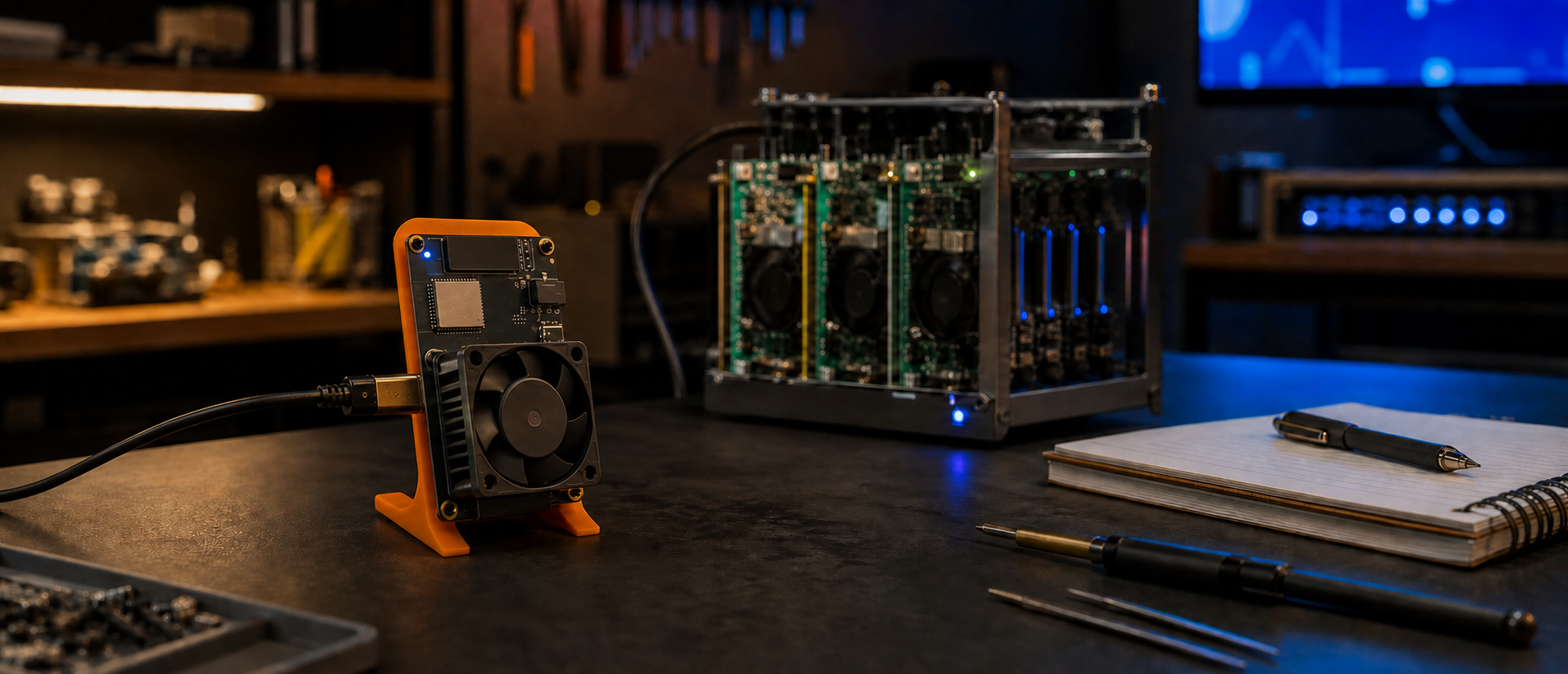
Bitaxe Townhall #62 put WallAxe at the centre of the latest OSMU discussion. Gio joined the town hall to explain a project that combines a Bitaxe and its power supply in a compact enclosure that plugs directly into a wall outlet.
The idea is easy to understand. A normal Bitaxe installation has a board, a separate power supply, a cable and some way to keep the assembly stable and clear of obstructions. WallAxe aims to turn those pieces into something closer to a small appliance.
That sounds like a packaging change, but it raises useful questions about where the Bitaxe ecosystem is going.
WallAxe and the next stage of home mining
WallAxe is best understood as a conversion and packaging project, not a new mining ASIC. It builds around existing Bitaxe hardware and tries to remove several points of friction for a new owner – choosing a suitable supply, managing the cable and mounting the equipment neatly.
For an experienced builder, those jobs are manageable. For someone buying a first small miner, they are among the least polished parts of the experience. A well-designed integrated unit could make a Bitaxe easier to place and easier to explain without changing what the board does.
The trade-off is safety. Once a product connects directly to household mains power, enclosure design, insulation, heat, clearances, strain relief and safe servicing matter more than appearance. A compact enclosure also has less room to move heat away from the miner and its power electronics.
The practical test for WallAxe will therefore be whether it can preserve the openness and repairability that make Bitaxe interesting while meeting the expectations people reasonably have for a mains-connected appliance. Until the design is mature and independently evaluated, it should be treated as a developing open-hardware project rather than a finished consumer product.
ESP-Miner 2.14.2 remains the current verified release
The latest verified ESP-Miner release remains version 2.14.2, released on July 8. Its published changes include a fix for a use-after-free race condition and a correction to frequency fallback during self-test.
That does not mean every owner should update immediately. Firmware work is a maintenance decision, not a reflex.
Before changing firmware, record:
- the Bitaxe model and hardware revision;
- the current firmware version;
- pool and network settings;
- normal temperature, fan speed and hash rate;
- any recurring errors or recovery behaviour.
Then read the release notes, confirm that the image matches the hardware, keep a recovery path available and change one thing at a time. A baseline makes it possible to tell whether an update improved reliability or merely changed the symptoms.
BM1373 parts are becoming easier to obtain
BM1373 has also moved a little closer to practical experimentation. TinyChipHub is advertising individual BM1373 chips at US$69.99. The seller describes about 2.5 TH/s as a reference point for sustained operation and much higher figures as overclocking tests with sharply increased power use.
Those are vendor claims, not independent finished-device benchmarks. The parts are also described as coming mainly from dismantled Antminer S23 Hydro equipment, which adds another variable for designers and buyers.
The important development is not the headline hash rate. It is that independent builders can now obtain parts for prototypes in small quantities. Turning a bare ASIC into a dependable miner still requires board design, voltage regulation, cooling, firmware support and a supply chain that can deliver chips of consistent quality.
BM1373 may support a higher-performance generation of open miners, but a seller’s chip-level number should not be treated as the expected performance of a future Bitaxe or NerdQAxe product.
A broader range of open miners
The official Bitaxe organization now includes projects such as the dual-chip Gamma Turbo and the multi-chip Gamma Hex alongside the established single-chip boards. WallAxe explores a different direction – not simply more hash rate, but a cleaner physical installation.
That variety is a sign of a maturing ecosystem. Open home mining is separating into several practical categories:
- low-power single-chip boards for learning and experimentation;
- multi-chip designs for more hash rate on a desk or shelf;
- display and interface projects that make monitoring easier;
- packaging and power projects intended to simplify installation;
- next-generation ASIC experiments whose real performance is still being established.
For an owner, the useful question is not which design has the largest number in a listing. It is which design fits the available power, cooling, noise tolerance, network and maintenance skills.
What to watch next
Three things are worth following over the next few weeks:
- Whether WallAxe publishes enough design and safety detail for meaningful community review.
- Whether ESP-Miner reliability reports settle around 2.14.2 or lead to another maintenance release.
- Whether BM1373 prototypes produce repeatable efficiency and thermal results outside vendor demonstrations.
The direction remains encouraging. Bitaxe is becoming more than a single board. It is an open ecosystem of hardware, firmware, enclosures, power systems, monitoring tools and operating practices. The next step is proving that added convenience and performance can arrive without giving up safety, transparency or repairability.
For a practical owner workflow, see Bitcoin Mining with Bitaxe and the free Bitaxe Owner’s Maintenance and Troubleshooting Pack.
– Greg Weir, Tartanleaf