
The past few weeks have brought a few different kinds of progress in open-source home mining. The Bitaxe community has been talking about how AI might fit into development, a new exhibition in Dresden puts home mining in a wider historical context, and I’ve been testing a monitoring dashboard of my own.
AI comes up at Bitaxe Townhall #64
The October 4 OSMU Bitaxe Townhall included a discussion about using AI in development—and where its limits should be. The episode description frames it as a practical question: AI may be useful in development, but people still need to decide what work to trust it with.
That seems like the right way to approach it. AI can help with repetitive setup and testing tasks, but it doesn’t take responsibility for understanding the code or deciding whether a change is ready. In an open-source project, maintainers and contributors still need to review what goes in and consider how it might fail.
The discussion is worth a listen for people following the software side of the Bitaxe ecosystem, even if they aren’t writing firmware themselves.
Home mining in a museum exhibition
A new exhibition, Crypto, what?, opened at the Münzkabinett (Coin Cabinet) of the Dresden State Art Collections. It runs from October 3, 2026, to August 29, 2027, and looks at the history of money alongside encryption, digital currency and Bitcoin. Its description includes home-mining devices as part of the exhibition. Exhibition details
The public description doesn’t identify those devices as Bitaxe hardware, so I wouldn’t call this a Bitaxe exhibit. Still, it’s interesting to see home mining presented as one part of a larger history of money and technology, not only as a competition to produce more hashrate.
A practical project I’ve been working on: homeHash
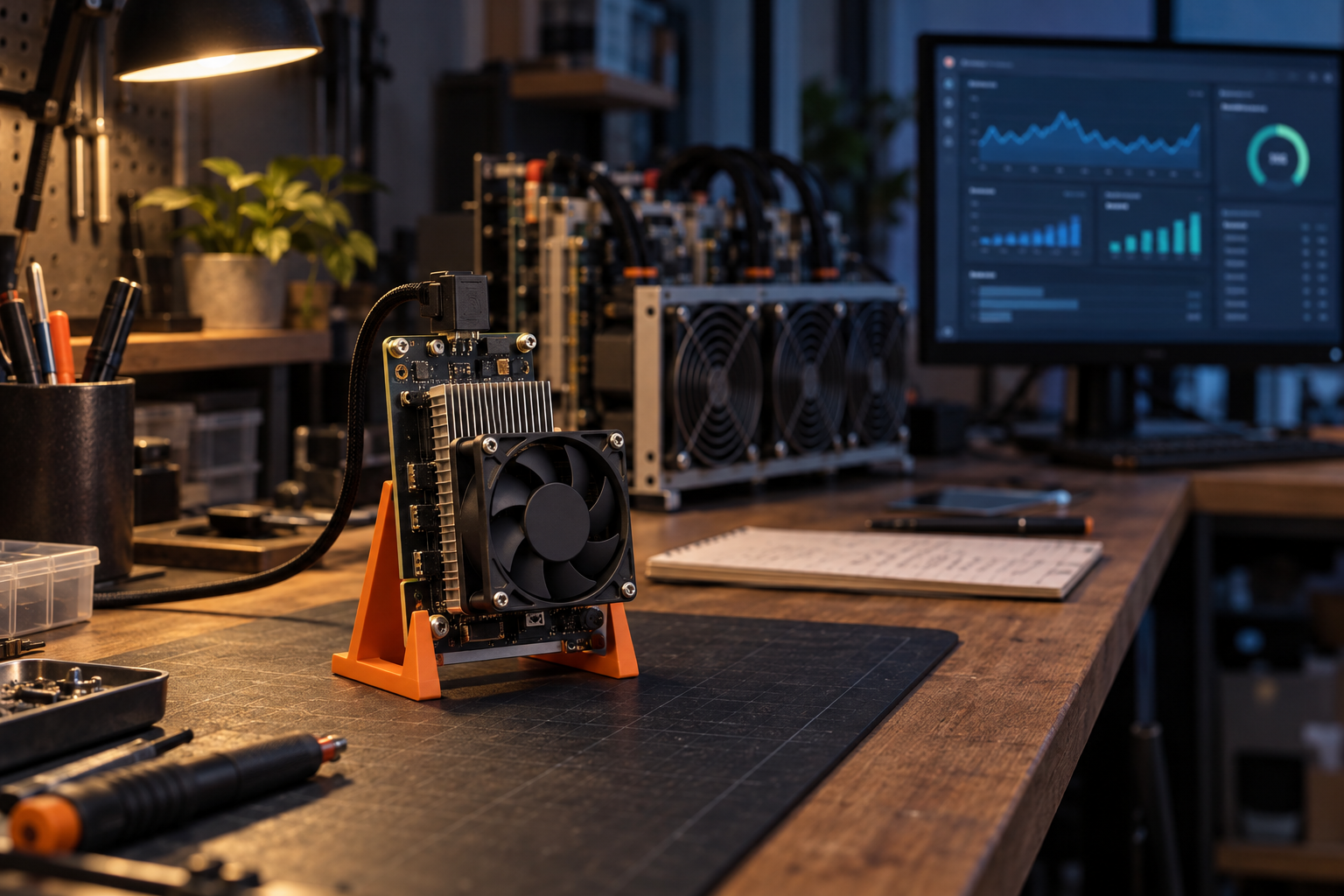
I’ve also been building homeHash, a monitoring dashboard for people running miners on a home network. It can discover Bitaxe miners and show information such as hashrate, temperature, pool connection and uptime, with history stored locally.
I wanted a way to see what a small group of miners was doing without relying on a cloud dashboard. The project is still in early development. I’ve tested its Bitaxe support with a Gamma 601 running AxeOS 2.15.3 and a GammaTurbo running AxeOS 2.12.0; that isn’t a claim that every model or firmware combination has been tested.
There are a couple of practical details to know. homeHash is intended for a private network and does not provide login or TLS, so its dashboard shouldn’t be exposed directly to the internet. Miner controls are optional and off by default. The project README has the current setup and security notes.
The BM1373 remains worth watching
The Naja Duo is still a useful example of newer ASIC hardware reaching a desktop-sized miner. Solo Satoshi lists its stock performance at about 4.4 TH/s and 42 W, or roughly 9.5 J/TH. Those are vendor figures; results can vary between units and setups. Solo Satoshi’s Naja Duo information
For me, the interesting part isn’t only the number. It’s how hardware, firmware and monitoring tools fit together. A specification tells you what a product is expected to do; time spent running it tells you more about stability, heat and power use in an actual setup.
What I’m taking from this update
Open-source home mining is growing in more than one direction. There is ongoing work on hardware and firmware, more discussion about how development tools should be used, and a growing need for practical ways to understand what miners are doing once they’re running.
I’ll keep watching those pieces—and I’ll share what I learn as homeHash and the wider Bitaxe ecosystem develop.
— Greg Weir, Tartanleaf
Sources and verification notes
- OSMU Bitaxe Townhall #64
- Dresden State Art Collections exhibition description
- Solo Satoshi Bitaxe product information; performance figures are vendor specifications.
- homeHash repository and README