
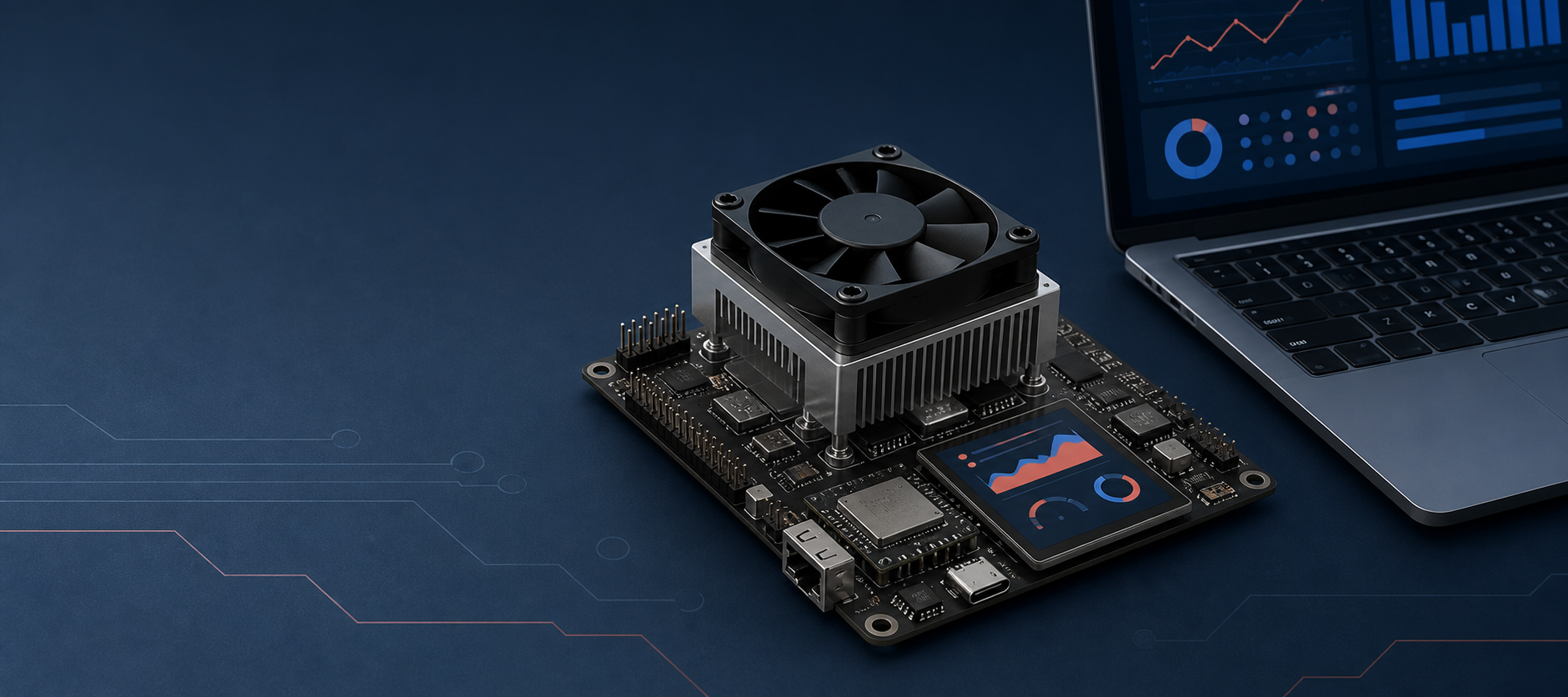
The last two weeks have moved the open-source home-mining story forward on two fronts at once. New BM1373-based hardware is moving from prototypes and announcements toward products people can order, while ESP-Miner 2.15.0 changes the way Bitaxe firmware updates work.
There is also a useful caution running through all of this. A product announcement, an open hardware repository, firmware support and something you can buy today are four different things. They sometimes arrive together. Often they do not.
That distinction matters more as the Bitaxe family expands.
The Naja Duo brings BM1373 to a Bitaxe product
The headline hardware announcement is the Bitaxe Naja Duo 1201, launched by Solo Satoshi at the end of August. It uses two BM1373 ASICs, the newer generation of silicon associated with Bitmain’s S23 machines.
Solo Satoshi lists the Naja Duo at about 4.4 TH/s and 42 watts at its default settings, or roughly 9.5 joules per terahash. If those numbers hold across production units, that is a substantial efficiency improvement over BM1370-based desktop miners.
The vendor also reports an 8 TH/s overclock at about 92 watts and much higher results under experimental liquid cooling. Those figures are interesting, but I would treat them as demonstrations of headroom rather than recommended operating points. Higher clock speed, voltage and temperature all change the reliability equation. A quiet, efficient miner that runs consistently is usually more useful than a benchmark that cannot be sustained.
Other practical changes include individual chip-temperature monitoring, a larger colour display, an XT30 power connection and cooling designed for a two-chip board. The product is described as running the mainline ESP-Miner and AxeOS stack.
There is one naming wrinkle worth knowing. The older bitaxeorg/bitaxeNaja repository currently describes an untested two-chip BM1340 prototype, not the newly announced BM1373 Naja Duo. I have not found a corresponding BM1373 hardware repository in the Bitaxe organization as of August 30. That does not make the product claim false, but it does mean buyers should not assume that every reference to “Naja” describes the same board.
My practical advice is simple: verify the exact model number, firmware, warranty, power supply and published design files before ordering. For a newly launched model, I would also allow time for production owners to report thermals, stability and real wall-power measurements.
NerdAxe Gaia offers a single-chip route
The NerdAxe Gaia approaches BM1373 from the other direction. It is a single-chip desktop miner advertised at roughly 2.4 to 2.6 TH/s and about 25 watts, depending on the vendor listing. European listings currently describe it as a pre-order product with September shipping.
That makes it an interesting low-power entry into the new silicon generation, but there is an important firmware distinction: Gaia is part of the NerdAxe family. Its BM1373 support is in the ESP-Miner-NerdQAxePlus project, not the main Bitaxe ESP-Miner release.
The interfaces share a family resemblance, but firmware is hardware-specific. Do not choose a firmware file because the dashboard looks familiar. Use the release and flashing instructions for the exact board and revision you own. Early Gaia buyers should also expect its BM1373 support to be in the 1.1.0 pre-release line rather than the older stable branch.
ESP-Miner 2.15.0 simplifies Bitaxe updates
For existing Bitaxe owners, the most broadly useful development is ESP-Miner 2.15.0, released August 21.
The largest change is unified firmware. AxeOS is now embedded in esp-miner.bin, so the normal update no longer requires a separate www.bin upload. After installing 2.15.0, refresh the browser page so it loads the updated interface.
The release also adds mDNS support. On a network that supports it, you can reach a miner by its hostname—for example, bitaxe.local—instead of first looking up its IP address. This is convenient, although keeping a record of the IP address or DHCP reservation is still worthwhile when troubleshooting.
Other changes include better undervoltage information, total uptime and hash counts, multi-line charts, a restart confirmation, fixes for several memory and WebSocket problems, and further Stratum V2 work. The Stratum changes include larger frames, better handling of fractional pool difficulty and an optional per-pool authentication requirement.
This is a meaningful release, but “meaningful” does not mean “install immediately on every stable miner.” Before updating:
- Record your pool, network, frequency and voltage settings.
- Confirm that 2.15.0 supports your exact board revision.
- Download firmware only from the official ESP-Miner release page.
- Update one miner first if you operate several.
- Leave it at known-good settings while you confirm temperatures, accepted shares and stability.
If your miner is stable and you do not need the new features, waiting for more field experience is also a reasonable decision. I explain that decision process in Should You Update Bitaxe Firmware?.
OSMU adds the Gamma Hex to the hardware conversation
The item I found on OSMU that was not in my initial notes is the Bitaxe Gamma Hex 1300. Its new Bitaxe organization repository describes a six-chip BM1370 design using an ESP32-S3, a colour display and ESP-Miner.
This belongs in the “watch the project” category for now. The repository is new, has only a small number of commits and does not yet publish a release. That is enough to establish that the design exists; it is not enough to treat it like a mature, widely available model.
The distinction is important. Open repositories let the community inspect and improve a design early. They are evidence of development, not automatically evidence of production readiness.
A more useful way to compare the growing model list
The market is becoming harder to describe with a single list of names. A better comparison asks four questions:
- Which ASIC and how many chips does the board use?
- Is the hardware design published, and where?
- Which firmware project supports the exact board revision?
- Is it a mature product, a new production model, a pre-order or an experimental design?
By that measure, the late-August picture is clearer:
- Naja Duo 1201: newly launched two-chip BM1373 product; attractive vendor specifications, with independent production experience still to come.
- NerdAxe Gaia: single-chip BM1373 product in pre-order or early-shipping status; uses the NerdQAxePlus firmware family.
- Gamma Hex 1300: newly published six-chip BM1370 open design; still early in its repository life.
- Existing Gamma, Supra, Ultra, Max and UltraHex designs: established reference points, although actual retail availability varies by model and vendor.
The important change is not simply that miners are getting faster. New-generation ASICs are reaching desk-sized, open-source hardware, while firmware and product families are becoming more specialized. That creates more choice, but it also puts more responsibility on the buyer to match the model, firmware and documentation correctly.
I will continue updating the Bitcoin Mining with Bitaxe Updates page as production experience catches up with the announcements.
For a practical guide to setup, tuning, monitoring and recovery, see Bitcoin Mining with Bitaxe. The free Bitaxe Owner’s Maintenance and Troubleshooting Pack provides printable baseline and troubleshooting worksheets.
— Greg Weir, Tartanleaf
Sources and verification notes
- ESP-Miner v2.15.0 release notes, released August 21, 2026.
- Solo Satoshi Naja Duo product page and launch article. Performance figures are vendor claims unless otherwise stated.
- Current
bitaxeorg/bitaxeNajaREADME, which describes a different BM1340 prototype. - NerdAxe Gaia product listing and ESP-Miner-NerdQAxePlus releases.
- OSMU Gamma Hex announcement and Bitaxe Gamma Hex repository.